Saturday, October 20, 2012

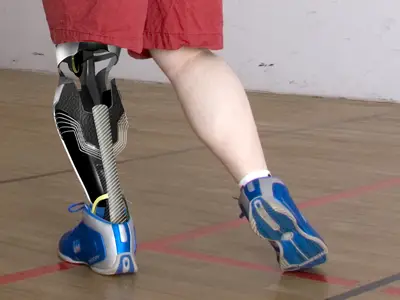
Video 4: How a Prosthetic Leg Works

This is a really great video that shows you exactly how a prosthetic leg connects to the body and what makes it work so well. It has light-weight carbon and aluminum parts as well as a "foot" that mimics a real foot. Because of this technology, so many people can walk. See if you can predict what new technological advances will do for the people who have prosthetics. Also, why do you think people may get new legs or hands every now and then?


How a Prosthetic Leg Works


Daniel, B. (2010, March 5). How a prosthetic leg works [Video file]. Retrieved from 
     http://www.youtube.com/watch?v=43WpTnJJuTE 
Website 4: How does a prosthetic hand work?


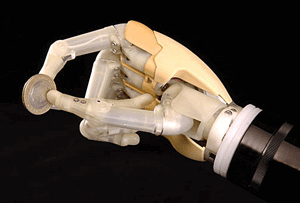
A lot has been done to help those (especially our vets) who have lost an arm or a leg. Many advances have been made on prosthetics to help people have more realistic feeling and function. This website has information about the science (mechanics and electrical impulses) that goes into making cutting edge prosthetics. See if you can identify the specific topics in physics that we have studied that are needed to make a prosthetic.

How does a prosthetic hand work?

Karns, K. (n.d.). How does a prosthetic hand work? Retrieved from http://www.ehow.com/ 
     how-does_4688048_prosthetic-hand-work.html 
Article 4: Do Artificial Limbs Enhance Athletes' Performance?


Do artificial limbs enhance athletes' performance?

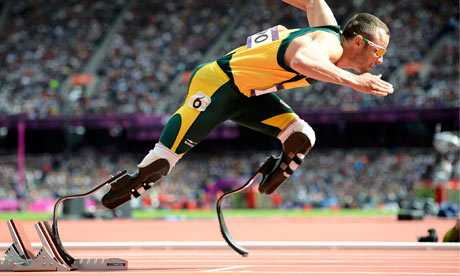
This past summer in the olympics in London, a man named Oscar Pistorius competed in the track and field competitions. But he had to fight to get there. Apparently someone thought that his prosthetics gave him an advantage. This article from 2009 explains some of the physics that went into both sides of the debate. What do you think? Did he have an unfair advantage?

Moseman, A. (2009, November 19). Scientist smackdown: Are a sprinter's prosthetic legs an unfair 
     advantage? Discover. 

Book 4: Physics, Fun and Beyond!

Have you ever wanted to do your own physics experiments? Now you can! This book contains more than 110 experiments that you can do with simple everyday objects. Learn how the world works and understand the laws of physics. I challenge you to look at the table of contents and try to predict what each experiment might show.


Physics, Fun and Beyond

de Campos Valadares, E. (2006). Physics, Fun and Beyond. Upper Saddle River, NJ: Pearson Education.

Friday, October 19, 2012

Video 3: BirdieBall


Ever wonder where Tiger Woods gets his near perfect swing? Yes, I know you stay awake at night wondering these things! Well, I have the answer for you! It is something called the BirdieBall! It is not even a "ball," but a cylinder with a hole in it. It helps the golfer perfect his swing by training him or her exactly how to hit the ball. If the BirdieBall is hit perfectly, it goes RIGHT into the hole. And, it makes a very loud sound. Watch this video to see how it could help your swing!

As you watch, pay special attention to the text that pops up during the video. At the end of the video, write a few sentences about how the BirdieBall can help a golfer's swing by taking advantage of physics.

What is a BirdieBall?

birdieball.com. (2010). BirdieBall golf channel [Video file]. Retrieved from http://www.youtube.com/ 
     user/jvbreaker?v=Egs27dgnBFQ 

Website 3: Physics.org

 
What a neat website. Basically everything you could or should know is at your fingertips. Find out what it would be like to live on Mars or how many times you can fold a paper bag (under the "Discover" tab). Or maybe you are interested in a career in physics: Search the "careers" tab to find out about the many different things you can do (from architecture to gaming and music). After exploring the site, I would like you to research 3 different careers in physics that sound interesting to you.

Your Guide to Physics on the Web

Physics.org. (n.d.). Retrieved October 19, 2012, from Your Guide to Physics on the Web website: 
     http://www.physics.org/index.asp 

Article 3: Electric Cars Charged Wirelessly!

"Kobot mini" single-seater electric vehicle displayed at the Eco Office Expo in Tokyo Thursday, July 12, 2012

Hey, guess what? It could be possible to charge electric cars wirelessly! Basically, instead of plugging the car in (like normal), now it might be possible to simply drive the car over a port in the ground to let it charge up. These ports could even be placed in many different areas across a city, so that a car could get a full charge in the middle of a trip. It is a new spin on the gas station. Read the article below for more information. Come to class ready to discuss two positives and two negatives of this technology.

Click on this link to find out how this technology could work!
How to Charge Electric Cars Wirelessly

Madslien, J. (2012, July 26). 'Perpetual motion' drives electric cars forward. BBC News, Business. 

Book 3: The Physics of Superheroes

Have you ever wondered how Spider Man's webs work? Or why kryptonite is so bad for Superman? Sources say that this book has all of the answers. Named one of the best science books in 2005 by Discover magazine, Mr. Kakalios uses real science to explain the powers (or weaknesses) of your favorite comic book heroes in this 2nd edition. (And, Mr. Kakalios is a pro: He is a physics and astronomy professor at the University of Minnesota!)

Go to this site to check out the book. The Physics of Superheroes
Kakalios, J. (2009). The physics of superheroes. New York, NY: Penguin Group. 


The Physics of Superheroes: Spectacular Second Edition

Monday, October 1, 2012

Article 2: The Physics of Changing Lanes


Ever want to get around that slow-poke in front of you? Do you typically pass a lot on the road or are you content to stay behind a car once you get to your preferred lane? This article investigates the physics behind changing lanes. Does it really help to change lanes a lot? What happens to your overall speed when you change lanes? Are most people content to stay put?

As you read this article, I want you to think about the information presented by using the following questions:

1. How often do you change lanes, and why?
2. How will you apply this scientific knowledge to your driving? Will it make any difference?
3. What are other habits that you have that might be changed by learning the science behind them?

Go to this link:
Stay Patient, Stay Alive

Foer, J. (2005). Stay patient, stay alive. Discovery, 26(4), 26-27. 
Video 2: How a combustion engine works

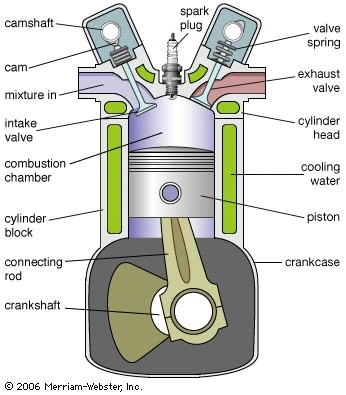
How is a car assembled? What is all of that stuff under the hood? What does it do? How does turning a key make the car turn on? What makes it "run?" Watch this video to see what happens within the car engine.


As you watch this video, record at least 10 vital parts to the car engine. Then briefly explain (in a complete sentence) the purpose of these mechanical components within the combustion engine and how they make a car operate.

Go to this link:
How Does a Combustion Engine Work?

4-cycle internal combustion engine - mechanical parts. (2008) http://www.youtube.com/watch?v=wRIKJ6Av5zo. Video posted originally on www.monkeysee.com, Produced by Knowlera Media, LLC.

Website 2: Car Accidents

5.accident

Car accidents are really scary, and I hope you all drive safely once you get your licenses: no distracted driving!!! There are also many physics concepts involved in car accidents. As you look at these pictures, see if you can determined the following:

1. How did the accident occur?
2. What laws of motion were present in this accident?
3. How could this accident have been prevented?

Go to this link:
10 Strange Car Accidents

We will be discussing these pictures in class, so be sure to bring your typed summary (and answers to the above 3 questions) on 5 of the pictures. If your last name begins with A-M, you will analyze the first 5 pictures. If your last name begins with N-Z, you will analyze the last 5 pictures.

10 strange car accidents that cannot be explained. (n.d.). Retrieved from http://smashingtops.com/ 
     funny/10-strange-car-accidents-that-cannot-be-explained/ 

Book 2: Car Science

Ever wonder how a car works? The operation of a car involves many different parts of physics. Newton's laws of motion are important for displacement, velocity and acceleration. Additionally, it is important to understand how engines work. There are many different types of engines: steam, electrical and gas-powered. Hybrid cars today utilize gas and electrical components in the engines.

Read this book to discover the different types of physics and science that are involved in making and driving a car. Sources say that this book describes the inner workings of a car in very easy to understand language.

Hammond, R. (2008). Car Science. New York, NY: Dorling Kindersley. 

Go to this link:
Car Science

Car Science (French Edition)