Friday, October 19, 2012

Book 3: The Physics of Superheroes

Have you ever wondered how Spider Man's webs work? Or why kryptonite is so bad for Superman? Sources say that this book has all of the answers. Named one of the best science books in 2005 by Discover magazine, Mr. Kakalios uses real science to explain the powers (or weaknesses) of your favorite comic book heroes in this 2nd edition. (And, Mr. Kakalios is a pro: He is a physics and astronomy professor at the University of Minnesota!)

Go to this site to check out the book. The Physics of Superheroes
Kakalios, J. (2009). The physics of superheroes. New York, NY: Penguin Group. 


The Physics of Superheroes: Spectacular Second Edition

Monday, October 1, 2012

Article 2: The Physics of Changing Lanes


Ever want to get around that slow-poke in front of you? Do you typically pass a lot on the road or are you content to stay behind a car once you get to your preferred lane? This article investigates the physics behind changing lanes. Does it really help to change lanes a lot? What happens to your overall speed when you change lanes? Are most people content to stay put?

As you read this article, I want you to think about the information presented by using the following questions:

1. How often do you change lanes, and why?
2. How will you apply this scientific knowledge to your driving? Will it make any difference?
3. What are other habits that you have that might be changed by learning the science behind them?

Go to this link:
Stay Patient, Stay Alive

Foer, J. (2005). Stay patient, stay alive. Discovery, 26(4), 26-27. 
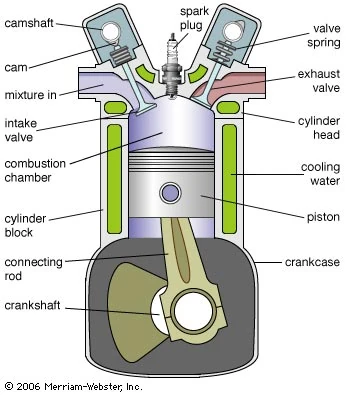
Video 2: How a combustion engine works

How is a car assembled? What is all of that stuff under the hood? What does it do? How does turning a key make the car turn on? What makes it "run?" Watch this video to see what happens within the car engine.


As you watch this video, record at least 10 vital parts to the car engine. Then briefly explain (in a complete sentence) the purpose of these mechanical components within the combustion engine and how they make a car operate.

Go to this link:
How Does a Combustion Engine Work?

4-cycle internal combustion engine - mechanical parts. (2008) http://www.youtube.com/watch?v=wRIKJ6Av5zo. Video posted originally on www.monkeysee.com, Produced by Knowlera Media, LLC.

Website 2: Car Accidents

5.accident

Car accidents are really scary, and I hope you all drive safely once you get your licenses: no distracted driving!!! There are also many physics concepts involved in car accidents. As you look at these pictures, see if you can determined the following:

1. How did the accident occur?
2. What laws of motion were present in this accident?
3. How could this accident have been prevented?

Go to this link:
10 Strange Car Accidents

We will be discussing these pictures in class, so be sure to bring your typed summary (and answers to the above 3 questions) on 5 of the pictures. If your last name begins with A-M, you will analyze the first 5 pictures. If your last name begins with N-Z, you will analyze the last 5 pictures.

10 strange car accidents that cannot be explained. (n.d.). Retrieved from http://smashingtops.com/ 
     funny/10-strange-car-accidents-that-cannot-be-explained/ 

Book 2: Car Science

Ever wonder how a car works? The operation of a car involves many different parts of physics. Newton's laws of motion are important for displacement, velocity and acceleration. Additionally, it is important to understand how engines work. There are many different types of engines: steam, electrical and gas-powered. Hybrid cars today utilize gas and electrical components in the engines.

Read this book to discover the different types of physics and science that are involved in making and driving a car. Sources say that this book describes the inner workings of a car in very easy to understand language.

Hammond, R. (2008). Car Science. New York, NY: Dorling Kindersley. 

Go to this link:
Car Science

Car Science (French Edition)

Friday, September 28, 2012

Website 1: How Roller Coasters Work!


How does a roller coaster work? Why don't you fall off? This is a really neat website that tells you how everyday things in your life work. In the link below, the authors describe the physics necessary for roller coasters.

How Stuff Works: Roller Coasters

Read a couple of pages and see if you can pick out some terms that we have talked about in class. Think about your favorite roller coaster (or one that looks like fun). What could you do to it to make it better? Is this physically possible?

Harris, T. (n.d.). How Roller Coasters Work. Retrieved from http://science.howstuffworks.com/ 
     engineering/structural/roller-coaster1.htm 


Video 1: Angry Birds in Space

As Newton has discovered, gravity is a pretty interesting thing... It is what keeps us here on earth. It is also responsible for creating what we call a trajectory (the curve a ball follows when it is thrown horizontally). You have also seen this when you play your Angry Birds game. What happens when we don't have gravity? In this video, astronaut Don Pettit describes what happens to the trajectory of an object (an Angry Bird) in space.


Llewellyn, A. (2012, March 8). Angry birds in space [Blog post]. Retrieved from http://open.nasa.gov/ 
     blog/2012/03/08/angry-birds-space/